
The History of the Rosary
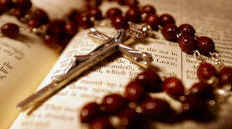 The
prayers of the Rosary are vocal and mental, centering on several repeated
prayers and other prayers/declarations recited only once. The mental prayer
focuses on the meditation of the chief mysteries of the life, death, and glory
of Jesus Christ, the life of the Virgin Mary, and our redemption.
The
prayers of the Rosary are vocal and mental, centering on several repeated
prayers and other prayers/declarations recited only once. The mental prayer
focuses on the meditation of the chief mysteries of the life, death, and glory
of Jesus Christ, the life of the Virgin Mary, and our redemption.
The story of the Rosary is as old as the Church. The complete Rosary consists of twenty mysteries: five "Joyful Mysteries," five "Luminous Mysteries," five "Sorrowful Mysteries," and five "Glorious Mysteries." With each "Hail Mary, it is a belief that the one praying offers the gift of a "rose" of prayer to Mary in her role as the Blessed Mother of the children of God (Revelation 12:13-17) and for her son, our Savior, Jesus. This form of prayer, therefore, came to be known as a rosarium, a rose garden of prayer. There are many different ways to pray the Rosary, but most often, six prayers are offered: "The Apostle's Creed," "The Lord's Prayer," the "Hail Mary," the "Glory Be," "The Prayer of Fatima," and the "Hail Holy Queen." Sometimes, a seventh prayer is added: "The Prayer of St. Michael the Archangel.
The Apostles' Creed (Symbolum Aposticum)
I believe in God, the Father Almighty, Creator of Heaven and earth, and in Jesus Christ, His Son, our Lord, who was conceived by the Holy Spirit, born of the Virgin Mary, suffered under Pontius Pilate, was crucified, died, and was buried. He descended into hell; the third day, He rose again from the dead. He ascended into Heaven and sits at the right hand of God, the Father Almighty; from thence He shall come to judge the living and the dead. I believe in the Holy Spirit, the holy Catholic Church, the communion of Saints, the forgiveness of sins, the resurrection of the body, and life everlasting. Amen.
The Apostles' Creed is the oldest Christian profession of faith and dates to the 1st century AD. According to tradition, the Church received the "Apostles' Creed" prayer from the Apostles themselves, probably at the Council of Jerusalem in 49/50 AD or shortly after. Since the Apostles were, by birth, products of the Old Covenant Church, they naturally wanted a new summary statement of personal belief. They would have wanted a prayer similar to the Old Covenant Shema, which began: "Hear, O Israel: YHWH is our God; YHWH is One," or the cultic credo associated with the renewal of the covenant with the generation that conquered Canaan in Joshua 24:2-13. The traditional word for such a summary statement is symbolum in Latin (in Greek, symblon). Rufinus of Aquileia's (d. 410) commentary on the Apostles' Creed is the earliest surviving such work. He wrote that early Christians called the Apostles' Creed a symbolum because it was like the passwords (symbola distincta) military commanders gave their troops to identify themselves from one another and distinguish themselves from the enemy. Therefore, he wrote, the Apostles' Creed was thought of as a symbol of faith whereby Christians safely identified themselves to one another. This is why, even today in the Latin Church, the Apostles' Creed is called the Symbolum Apostolicum.
The Apostles' Creed summarizes the Apostles' faith, as Jesus taught it to them and as they shared their experience in continuing the Messiah's mission. It declares what Christians profess to believe as New Covenant Christians and is the ancient baptismal symbol of the Church of Rome. St. Ambrose described the Apostles' Creed as "the Creed of the Roman Church, the See of Peter, the first of the Apostles, to which he brought the common faith" (St. Ambrose, Explanatio Symboli 7).
The Lord's Prayer (Pater Noster)
Our Father, who art in Heaven, hallowed be Thy name. Thy kingdom come, Thy will be done on earth as it is in Heaven. Give us this day our daily bread; and forgive us our trespasses, as we forgive those who trespass against us; and lead us not into temptation, but deliver us from evil. Amen.
The story of the Rosary and the prayers associated with it, as we meditate on the life of Christ and His mother, is as old as the Church. Our Lord Jesus composed "The Our Father/Lord's Prayer" (Pater Noster), forming a framework for the Rosary. He taught His disciples seven petitions to make to the Father when they asked for an example of how they should offer communal prayer (Matthew 6:7-13; five petitions in Luke 6:9-13). The early Christians took His command seriously when Jesus said, "In this manner, therefore, you shall pray" (Matthew 6:9). Many early Christians, especially those who lived in monastic communities, prayed "The Lord's Prayer" with the 150 Psalms, keeping track of their prayers with 150 pebbles. By the 4th century AD, evidence shows that ordinary people began to take up this practice. However, since most could neither read nor afford a handwritten copy of the Psalms, they repeated the "Our Father" (the Lord's Prayer) 150 times by memory.
The Hail Mary Prayer (Ave Maria)
Hail Mary, full of grace, the Lord is with you. Blessed are you among women, and blessed is the fruit of your womb, Jesus. Holy Mary, Mother of God, pray for us sinners, now and at the hour of our death. Amen.
The addition of the greeting of the Angel Gabriel to Mary: "Hail, full of grace, the Lord is with you" (Luke 1:28) at the Annunciation seems to have begun in the Church at Ephesus, where St. John, the Beloved Apostle, served for many years as that community's bishop. According to tradition, Mary lived for several years at Ephesus, in modern-day Turkey, under the care of St. John, in obedience to Jesus' command to both Mary and St. John as they stood at the foot of the Cross (John 19:25-27). It was natural for those praying the angelic greeting to add Mary's name, so they prayed: "Hail Mary, full of grace, the Lord is with you!"
The angel's greeting identifies the Virgin Mary as full of God's grace. The divine grace which fills Mary is the presence of the One who is the source of all grace. God fills and indwells Mary in the same way His Presence filled the Tabernacle and dwelled above the Mercy Seat of the Ark of the Covenant, Israel's most sacred shrine (Exodus 24:22; 40:34). Mary is also the symbol of the "daughter of Zion" (Zion is another word for Jerusalem and the Old Covenant Church). The prophet Zephaniah wrote: "Rejoice... O daughter of Jerusalem ... the Lord your God is in your midst" (Zeph 3:14, 17a). Her womb became the Ark of the New Covenant, the dwelling place of God with humanity (Rev 21:3). Soon, the first line of St. Elizabeth's greeting to Mary, when she visited her kinswoman who was pregnant with St. John the Baptist, was added to the prayer: "Blessed are you among women and blessed is the fruit of your womb, Jesus" (Luke 1:42). It was a greeting in which St. Elizabeth acknowledged Mary as "the mother of my Lord," meaning the mother of God (Luke 1:43).
The Christian community at Ephesus in Asia Minor had a special devotion to the Virgin Mary. At the Council of Ephesus in 431, the universal Church declared that the Virgin Mary rightly deserved the title St. Elizabeth gave her: "Mother of my Lord," identifying Mary as "Mother of God." The Council proclaimed that Mary, as the mother of the man-God Jesus, was indeed the "Mother of God," not just the mother of the human Jesus. After the Council announced its decision, the people of Ephesus took to the streets, shouting the proclamation in a spontaneous petition to the Virgin Mother: "Holy Mary, Mother of God, pray for us!"
The final portion of the "Hail Mary" petition was not added until the terrible years of the 14th century, as the plague known as "the Black Death" ravaged Europe. It was then that the people of the Church cried out to the Blessed Mother in fear and hope, changing the petition to "Holy Mary, Mother of God, pray for us sinners now and at the hour of our death. Amen."
By the 8th century AD, monks replaced the pebbles they used to count their prayers with knotted cords, and by the 11th century, the current form of the "Hail Mary," prayed 150 times and divided into three sets of fifteen decades, replaced the 150 Psalms. In 1040, a noble English lady named Godiva bequeathed in her will that her beautiful Rosary would become the property of the Abby she founded and be worn by the statue of the Blessed Virgin. Her will described a Rosary made of precious stones divided into fifteen decades, with each decade divided by larger precious stones. Her testament is the earliest surviving description of the Rosary in its present form.
The repetition of the "Hail Mary" throughout the Rosary cycle of prayer is not mindless chanting. Repeating the ten "Hail Mary" prayers as one contemplates each mystery helps the mind focus on the event at the center of the prayer. The repetition also blocks worldly thoughts that may try to disrupt the experience. The goal is to leave behind our ties to the mundane and to enter into an understanding of Jesus and His mother that becomes a present reality in our life's journey with Christ to eternal salvation.
The Glory Be (Gloria Patri)
Glory be to the Father, and to the Son, and to the Holy Spirit. As it was in the beginning, it is now, and ever shall be, world without end.
The fourth prayer, the Gloria Patri, "Glory Be," is a prayer of joy and praise. The earliest surviving examples of this doxology in Latin Christian writings date to the 600s AD. The original Latin prayer ends with "secular secularum" ("age of ages"). Our English translation is wrong because, when Christ returns in glory, this earthly world will end. It was probably an adaptation of the Jewish blessings addressed to God, like those found in the New Testament in Romans 16:27, Philippians 4:20, and Revelation 5:23. This prayer comes after the repetition of a decade of "Hail Mary" prayers during which one meditates on the mission of the Son of God through Mary's experiences as a participant in God's plan for humanity's salvation.
Pope Francis has suggested adjusting the English version of the prayer to reflect the Latin version more accurately by saying, "Glory be to the Father, and to the Son, and to the Holy Spirit." As He was in the beginning, He is now and ever shall be beyond the age of ages. Latin uses an indefinite pronoun, but the Most Holy Trinity is more correctly referred to as He, not It, and beyond the age of ages is the correct translation of the Latin secular secularum. In addition, according to Scripture, when Christ returns in glory, the world as we know it will end: But the day of the Lord will come like a thief, and then the heavens will pass away with a mighty roar and the elements will be dissolved by fire, and the earth and everything done on it will be found out (2 Peter 3:10 NABRE).
Hail Holy Queen (Salve Regina)
Hail, Holy Queen, Mother of Mercy, our life, our sweetness, and our hope. To thee do we cry, poor banished children of Eve. To thee do we send up our sighs, mourning and weeping in this valley of tears. Turn then, most gracious Advocate, thine eyes of mercy toward us. And after this our exile, show unto us the blessed fruit of thy womb, Jesus. O clement, O loving, O sweet Virgin Mary. Pray for us, O holy Mother of God, that we may be made worthy of the promises of Christ.
The fifth prayer, "Hail Holy Queen," is a prayer of love to our Mother Mary, composed in the 11th century, probably by a poor, disfigured monk named Hermannus Contractus (d. 1054). It was a plea of such heartfelt trust in Mary's motherly love that the laity and clergy soon added it to the prayers of the Rosary. The prayer acknowledges Mary as the rightful Davidic Queen, the Gebirah, honored as the Queen of her son's Kingdom and Advocate of His faithful subjects (1 Kings 2:13-18). Jesus fulfills God's covenant with David that his throne would endure forever (2 Samuel 7:16; Luke 1:32-33). Since a Davidic king of Israel had many wives, the Queen of his kingdom was his mother, who sat on a throne to his right (1 Kings 2:19). The Church grants a partial indulgence for every recitation of this prayer.
In the next several centuries, both St. Dominic (1215) and the Blessed Alan de la Roche (1460) received instruction from the Virgin Mary on using the Rosary. She instructed them to encourage recitation of the Rosary's prayers with meditations on Christ's life. She promised spiritual gifts from a devotion to the Rosary, telling St. Dominic that the regular practice of the Rosary "will cause virtue and good works to flourish" and that the Rosary would obtain for souls "the abundant mercy of God." Among other promises, she said that "the rosary shall be a powerful armor against Hell; it will destroy vice, decrease sin, and defeat heresies." In 1567, the Church formally established the Rosary as a form of public and private devotion of the Universal (Catholic) Church.
The Prayer of Fatima
O my Jesus, forgive us our sins, save us from the fires of hell, lead all souls to Heaven, especially those who have most need of your mercy.
The Virgin Mary added the sixth prayer, "The Prayer of Fatima." It is the prayer she taught three children at Fatima in the mountain region of central Portugal during six apparitions from May 13th to October 13th, 1917. At each visitation, she introduced herself as the "Lady of the Rosary." She told the young visionaries to believe in her Immaculate Conception, to tell the faithful to do penance, and to pray the Rosary because otherwise, the world would be punished for its sins. From her apparitions at Lourdes (France) in 1854 and Fatima (Portugal) in 1917, whenever the Virgin Mary appears, she prays the Rosary with those near her, just as she prayed the Rosary with St. Dominic and the Blessed Alan.
In 2002, Pope St. John Paul II added five Luminous Mysteries to the meditation on the life of Christ through Mary's experience of the divine Messiah. He wrote in Rosarium Virginis Mariae that reciting the Rosary with contemplation of the mysteries of the life of Jesus Christ is genuine "training in holiness" for Christians. Adding the Luminous Mysteries to the Joyful, Glorious, and Sorrowful Mysteries completes the meditation on the events of Christ's life. The prayers take us from His birth and ministry to His self-sacrificial death, Resurrection, and glorious Ascension, and to welcoming His mother into His heavenly Kingdom, which promises our hoped-for bodily resurrection. Pope St. John Paul II recommended the Virgin Mary as a model of contemplation. He invited the faithful to embrace Jesus's words from the altar of the Cross, spoken to each of us as the "beloved disciple," to "Behold your Mother!"
The Memorial of Our Lady of the Rosary
On October 7th, the Church celebrates the Memorial of Our Lady of the Rosary. Pope St. Pius V established this feast following the victory of the small Christian navy over a large Turkish Muslim fleet. The Christian navy, composed of ships from Spain, Venice, and Genoa and commanded by Don Juan of Austria, engaged a Turkish fleet of at least 15,000 ships at the Battle of Lepanto on October 7, 1571. Knowing the Muslims greatly outnumbered the Christian navy, Pope Pius V called on all of Europe to pray the Rosary for the Blessed Virgin's intercession in granting victory. The Christian commanders petitioned the Blessed Virgin's intercession as they prepared for the battle. Commander Don Juan's battle flag was an image of Christ crucified flown from the mast of his ship, and Admiral Andrea Doria carried a copy of Mexico's Our Lady of Guadalupe into the battle. Only forty years earlier, the Blessed Virgin appeared to a Mexican peasant named Juan Diego, promising her intercession for the people of Mexico and the defeat of the old pagan gods. Now, the Christian nations of Europe pleaded for her intervention in defeating a Muslim invasion that threatened all Christendom.
As the battle took place in the Gulf of Patras off the coast of southwestern Greece, the Confraternity of the Rosary in Rome marched in solemn procession as the faithful prayed to the Virgin Mary to intercede for victory over the Turkish aggressors. When the smaller Christian navy won, Pope Pius V attributed its success to the intercession of the Blessed Virgin, calling her "Mary, succor of Christians." The decisive defeat of the Turkish navy prevented the intended Islamic invasion of Europe and the destruction of Christianity. The Church celebrated the feast for many years and called it "Our Lady of the Victory." Later, the Church renamed it "Our Lady of the Rosary." In 1716, Pope Clement XI, who canonized Pope Pius V in 1712, extended the celebration throughout the Universal Church.
Praying the Rosary as a Spiritual Exercise
Meditating on Jesus's mission through the Rosary is a spiritual exercise. It should engage our thoughts, imagination, emotions, and desire to develop a deeper personal relationship with the Savior as the Holy Spirit guides us in our contemplation. The Rosary permits us to share in the mysteries of the Lord's life as seen through the eyes of His Blessed Mother, the one human being who knew Him best. By contemplating these mysteries, we can submit ourselves to imitating the virtues they contain, thereby seeking a more intimate connection to our Savior and His mission on behalf of fallen humanity. The beauty and spirituality of the Rosary lie in meditating on the mystery of our redemption again and again. We ponder these mysteries as precious treasures in our hearts, just as Mary did as these events unfolded in her life (Luke 2:19).
Instructions for praying the Rosary:
|
I. Praying the Rosary with the Bible and the Catechism: The Five Joyful Mysteries |
||
| Mystery | Scripture | Catechism reference |
| 1. The Annunciation | Mt 1:18-25; Lk 1:26-28, 30-36; Is 7:14; Ez 34:23-24; Zec 9:9-10; Zeph 3:14, 17 | CCC 430 |
| 2. The Visitation | Lk 1:39-45; Mt 12:31; Ps 138:1-2 | CCC 717 |
| 3. The Nativity | Lk 2:8-21; Mic 5:1/2-3/4 | CCC 563 |
| 4. The Presentation | Lk 2:22-38; Ex 13:2; 13:11; Lev 5:7; 12:2-4, 8; Mt 2:1-23 | CCC 529 |
| 5. Finding Jesus in the Temple | Lk 2:43-50 | CCC 534 |
|
II. Praying the Rosary with the Bible and the Catechism: The Five Luminous Mysteries |
||
| Mystery | Scripture | Catechism reference |
| 1. Jesus' Baptism by St. John | Mt 3:13-17; Mk 1:9-11; Lk 3:21-22; Jn 1:29-34; Is 11:2; 42:1; Ps 2:7 | CCC 536 |
| 2. The Miracle at Cana | Jn 2:1-11 | CCC 1335 |
| 3. The Proclamation of the Kingdom | Mt 5:3; 10:6-7; Mk 1:14-15; Lk 4:14-21 | CCC 545 |
| >4. The Transfiguration | Mt 17:1-8; Mk 9:2-8; Lk 9:28-36; 2 Pt 1:16-18 | CCC 556 |
| 5. The Last Supper (Institution of the Eucharist) | Mt 26:26-29; Mk 14:22-25; Lk 22:19-20; 1 Cor 11:23-28 | CCC 1337 |
|
III. Praying the Rosary with the Bible and the Catechism: The Five Sorrowful Mysteries |
||
| Mystery | Scripture | Catechism reference |
| 1. The Agony in the Garden | Mt 26:36-46; Mk 14:32-42; Lk 22:40-46; Jn 18:1-11 | CCC 612 |
| 2. The Scourging | Mt 27:11-26; Mk 15:2-15; Lk 23:2-25; Jn 18:28-19:1, 4-16 | CCC 572 |
| 3. Jesus is Crowned with Thorns | Mt 27:27-30; Mk 15:16-20; Jn 19:2-6, 15-16 | CCC 602 |
| 4. Carrying the Cross to Golgotha | Mt 27:31-34; Mk 15:21-22; Lk 23:26-32, 38; Jn 19:17 | CCC 853 |
| 5. The Crucifixion | Mt 27:35-54; Mk 15:23-32; Lk 23:33-34; Jn 19:18-27; Ps 22 | CCC 623 |
|
IV. Praying the Rosary with the Bible and the Catechism: The Five Glorious Mysteries |
||
| Mystery | Scripture | Catechism reference |
| 1. The Resurrection | Mt 28:1-10; Mk 16:1-7; Lk 24:1-8; Jn 20:1-10, 19-23; Ps 16:10; 1 Cor 15:54-57 | CCC 657 |
| 2. The Ascension | Acts 1:6-11; Heb 1:3-4 | CCC 668 |
| 3. Descent of the Holy Spirit | Acts 2:1-4; Jn 3:4-8; Ez 36:25-28 | CCC 731 |
| 4. The Assumption of the Blessed Virgin | Lk 1:46-55; Zeph 3:14, 17 | CCC 966 |
| 5. The Coronation of Mary, the Davidic Queen | Rev 12:1, 5; | CCC 966 |
As a general rule, but depending on the liturgical season, pray the Joyful Mysteries on Monday and Saturday, the Luminous Mysteries on Thursday, the Sorrowful Mysteries on Tuesday and Friday, and the Glorious Mysteries on Wednesday and Sunday. Other suggested Catechism references: 967-972, 2673-2679, 2705-2719
Pope Francis requested adding the following prayers to the Rosary in May 2020 for Mary's intercession concerning the COVID-19 pandemic:
The First Prayer
"O Mary,
You shine continuously on our journey as a sign of salvation and hope.
We entrust ourselves to you, Health of the Sick, who, at the foot of the cross,
were united with Jesus's suffering and persevered in your faith. "Protectress
of the Roman people," you know our needs, and we know that you will provide so
that, as at Cana in Galilee, joy and celebration may return after this time of
trial. Help us, Mother of Divine Love,
to conform ourselves to the will of the Father and to do what Jesus tells us. For
he took upon himself our suffering and burdened himself with our sorrows to
bring us, through the Cross, to the joy of the Resurrection. Amen.
We fly to your
protection,
O Holy Mother of God;
Do not despise our petitions
in our necessities,
but deliver us always
from every danger,
O Glorious and Blessed Virgin."
Second Prayer
"We fly to your
protection, O Holy Mother of God. In the present tragic situation, when the
whole world is prey to suffering and anxiety, we fly to you, Mother of God and
our Mother, and seek refuge under your protection. Virgin Mary, turn your
merciful eyes towards us amid this coronavirus pandemic. Comfort those who are
distraught and mourn their loved ones who have died and, at times, are buried
in a way that grieves them deeply. Be close to those who are concerned for
their loved ones who are sick and who, in order to prevent the spread of the
disease, cannot be close to them. Fill with hope those who are troubled by the
uncertainty of the future and the consequences for the economy and employment. Amen."
The Third Prayer
"Mother of God and our
Mother, Pray for us to God, the Father of mercies, that this great suffering
may end, and that hope and peace may dawn anew. Plead with your divine Son, as
you did at Cana so that the families of the sick and the victims be comforted,
and their hearts be opened to confidence and trust. Protect those doctors,
nurses, health workers, and volunteers who are on the frontline of this
emergency and are risking their lives to save others. Support their heroic
effort and grant them strength, generosity, and continued health. Be close to
those who assist the sick night and day and to priests who, in their pastoral
concern and fidelity to the Gospel, are trying to help and support everyone.
Blessed Virgin, illuminate
the minds of men and women engaged in scientific research that they may find
effective solutions to overcome this virus. Support national leaders that, with
wisdom, solicitude, and generosity, they may come to the aid of those lacking
the basic necessities of life and may devise social and economic solutions
inspired by farsightedness and solidarity. Amen."
The Fourth Prayer
"Mary Most Holy, stir our
consciences so that the enormous funds invested in developing and stockpiling
arms will instead be spent on promoting effective research on how to prevent
similar tragedies from occurring in the future. Beloved Mother, help us realize
that we are all members of one great family and to recognize the bond that
unites us so that, in a spirit of fraternity and solidarity, we can help to
alleviate countless situations of poverty and need. Make us strong in faith,
persevering in service, constant in prayer.
Mary, Consolation of the
afflicted, embrace all your children in distress and pray that God will stretch
out his all-powerful hand and free us from this terrible pandemic so that life
can serenely resume its normal course. To you, who shine on our journey as a
sign of salvation and hope, do we entrust ourselves, O Clement, O Loving, O
Sweet Virgin Mary. Amen."
Michal E Hunt, Copyright © September 1999; revised 2026 Agape Bible Study. Permissions All Rights Reserved.