
THE BOOK OF JUDITH
Lesson 2:
Chapters 2-3
The Enemy's Campaign and the Stages of General Holofernes' Advance
In Chapter 2, the writer sets the time at 587-586 BC, when King Nebuchadnezzar II conquered and destroyed Jerusalem, looted and burned the Temple, and took the survivors into exile (2 Kgs 25:1-21; 2 Chron 36:11-21). His purpose is to contrast that disaster with the victory that Judith will win.
Judith 2:1-20 ~ The
Campaign in the West
1 In the eighteenth year, on the twenty-second day of the first month, a rumor ran
through the palace that Nebuchadnezzar, king of the Assyrians, was to have his
revenge on all the countries, as he had threatened. 2 Summoning his
general staff and senior officers, he held a secret conference with them, and
with his own lips pronounced utter destruction on the entire area. 3 It
was then decreed that everyone should be put to death who had not answered the
king's appeal. 4 When the council was over, Nebuchadnezzar, king of
the Assyrians, sent for Holofernes, general-in-chief of his armies and
subordinate only to himself. He said to him, 5 Thus speaks the
Great King, lord of the whole world, "Go; take men of proven valor, about a hundred-and-twenty-thousand-foot
soldiers and a strong company of horse with twelve thousand cavalrymen; 6 then
advance against all the western lands, since these people have disregarded my
call. 7 Bid them have earth and water ready, because in my rage I am
about to march on them; the feet of my soldiers will cover the whole face of
the earth, and I shall plunder it. 8 Their wounded will fill the
valleys and the torrents, and rivers, blocked with their dead, will overflow. 9 I shall lead them captive to the ends of the earth. 10 Now go!
Begin by conquering this whole region for me. If they surrender to you, hold
them for me until the time comes to punish them. 11 But if they
resist, look on no one with clemency, hand them over to slaughter and plunder
throughout the territory entrusted to you. 12 For by my life (as I
live) and by the living power of my kingdom I have spoken. All this I shall do
by my power. 13 And you, neglect none of your master's commands, act
strictly according to my orders without further delay." 14 Leaving
the presence of his sovereign, Holofernes immediately summoned all the
marshals, generals, and officers of the Assyrian army 15 and
detailed the picked troops as his master had ordered, about a hundred and
twenty thousand men and a further twelve thousand mounted archers. 16 He
organized these in the normal battle formation. 17 He then secured
vast numbers of camels, donkeys, and mules to carry the baggage, and
innumerable sheep, oxen, and goats for food supplies. 18 Every man
received full rations and a generous sum of gold and silver from the king's
purse. 19 He then set out for the campaign with his whole army, in
advance of King Nebuchadnezzar, to overwhelm the whole western region with his
chariots, his horsemen, and his picked body of foot. 20 A motley
gathering followed in his rear, as numerous as locusts or the grains of sand on
the ground; there was no counting their multitude.
Chapter 2 begins with another significant date in Nebuchadnezzar's reign and Israel's history. It is not only the date when Nebuchadnezzar II began the siege of Jerusalem that ended in the destruction of the city, the Temple, and the exile of its surviving people, but also the 22nd day of Nisan, the day after the end of the Feasts of Passover and Unleavened Bread. Passover was on Nisan 14th, and Unleavened Bread extended from the 15th to the 22nd (Ex 12:1-28).
The writer uses these two dates to remind readers of the Covenant people's most devastating defeat (587 BC) and Yahweh's greatest deliverance of His people in the prelude to the Exodus, which was later memorialized in the feasts of Passover and Unleavened Bread. See the handout showing the Seven Sacred Feasts of the Old Covenant.
The enemy, pictured as Nebuchadnezzar (again mislabeled as "king of the Assyrians"), plans his revenge on all the countries that did not answer his call to make war, as he had threatened (1:12), and is now searching for revenge, sending his commander-in-chief, Holofernes, on a punitive campaign.
5 Thus speaks the Great King, lord of the
whole world (the earth) ...
That the king is assuming the prerogatives of divinity
can be seen from the fact that he calls himself "the Great King" and "lord of
the whole earth," titles applied to Yahweh (see Ex:22; Jer 11:3; Amos 1:3;
Josh 3:11; Zech 6:5), and he swears with a formula proper to divinity in verse 12, "for
by my life/as I live" (see Is 49:18; Jer 22:24; Ezek 5:11). Other phrases
include "the whole face of the earth/ to the very ends of the earth" (see
1 Sam 2:10; Ps 59:14; Is 41:5); "what I have spoken I will accomplish by my
power," in verse 12 by the living power of my kingdom I have spoken. All
this I shall do by my power (compare with Dt 32:39;
Is 10:12-15; 43:13).
In fact, Nebuchadnezzar II did attempt to declare himself a god when he constructed a golden statue and commanded all peoples, nations, and languages to prostrate themselves before it in worship (Dan 3:1-7). Another enemy of the covenant people who was worshipped as a god was the Egyptian Pharaoh. Neither man succeeded in supplanting the God of Israel and was punished for their hubris. Each of the "divine figures" is represented by a mortal figure: Nebuchadnezzar by his general Holofernes and Yahweh by the holy woman Judith.1 Nebuchadnezzar's punishment of "the West," his attempt to destroy Judah/Israel, and his ultimate defeat are acted out in the figure of Holofernes.
7 Bid them have earth and water ready,
because in my rage I am about to march on them; the feet of my soldiers will
cover the whole face of the earth, and I shall plunder it. 8 Their
wounded will fill the valleys and the torrents, and rivers, blocked with their
dead, will overflow. 9 I shall lead them captive to the ends of the
earth.
Holofernes assembles a huge army composed of many
soldiers from different nations to carry out his campaign of destruction and
death. The order to "have earth and water ready" ("prepare earth and water") in
verse 7 is a Persian expression meaning having everything needed for a
conquering army to take over a country (Navarre: Judith, page 352).
Holofernes begins his campaign with an armed force of 120,000 soldiers and 12,000 horsemen (2:15-16). He sets out in verses 19-20 with his whole army, in advance of King Nebuchadnezzar, to overwhelm the whole western region with his chariots, his horsemen, and his picked body of foot. 20 A motley gathering followed in his rear, as numerous as locusts or the grains of sand on the ground; there was no counting their multitude.
Judith 2:21-28 ~ The Stages of General Holofernes' Advance
21 Thus they set out from Nineveh and
marched for three days towards the Plain of Bectileth. From Bectileth they went
on to pitch camp near the mountains that lie to the north of Upper Cilicia. 22
From there Holofernes advanced into the highlands with his whole army,
infantry, horsemen, chariots. 23 He cut his way through Put and Lud,
carried away captive all the sons of Rassis and sons of Ishmael living on the
verge of the desert south of Cheleon, 24 marched along the
Euphrates, crossed Mesopotamia, razed all the fortified towns controlling the
Wadi Abron and reached the sea. 25 Next he attacked the territories
of Cilicia, butchering all who offered him resistance, advanced on the southern
frontiers of Japheth, facing Arabia, 26 completely encircled the
Midianites, burned their tents and plundered their sheep-folds, 27 made
his way down to the Damascus plain at the time of the wheat harvest, set fire
to the fields, destroyed the flocks and herds, sacked the towns, laid the
countryside waste and put all the young men to the sword. 28 Fear
and trembling seized all the coastal peoples; those of Sidon and Tyre, those of
Sur, Ocina and Jamnia. The populations of Azotos and Ascalon were
panic-stricken.
In the first half of the second century BC, when the Seleucid kings of Syria dominated Judea, the situation described in Judith was very much what the Old Covenant Jews faced "military oppression and the attempt to impose king-worship.
The route the foreign army took in 2:21-3:10 is geographically unlikely. Even when the army reaches Samaria (Northern Israel's former capital that became the name of northern Israel), many of the place-names are largely unknown, a reminder that the author is not trying to w.
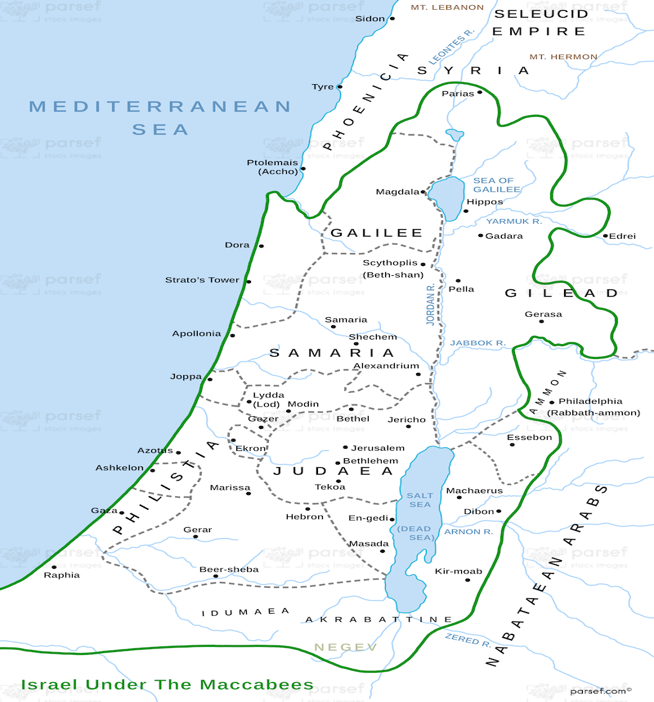
The inspired writer exaggerates the strength of Holofernes and his army to prepare the ground for the religious message he wants to convey. Consult the maps at the end of the lesson to identify the locations of some of the sites mentioned in the foreign army's advance.
This was more than a battle between men and nations. It was also a battle between gods, with each summoning the best in human power to defeat the other. The figure of Nebuchadnezzar represents a false god who trusts in human might, while Yahweh will use the human virtue of a young widow.
Judith 3:1-10 ~ The Stages
of the Enemy's Advance Continued and the Surrender of the West
1 They therefore sent envoys to him to sue for peace, to say, 2 "We are
servants of the great King Nebuchadnezzar; we lie prostrate before you. Treat
us as you think fit. 3 Our cattle-farms, all our land, all our wheat
fields, our flocks and herds, all the sheep-folds in our encampments are at
your disposal. Do with them as you please. 4 Our towns and their
inhabitants too are at your service; go and treat them as you think fit." 5
These men came to Holofernes and delivered the message as above. 6 He
then made his way down to the coast with his army and stationed garrisons in
all the fortified towns, levying outstanding men there as auxiliaries. 7 The
people of these cities and of all the other towns in the neighborhood welcomed
him, wearing garlands and dancing to the sound of tambourines. 8 But
he demolished their shrines and cut down their sacred trees, carrying out his
commission to destroy all local gods so that the nations should worship
Nebuchadnezzar alone and people of every language and nationality should hail
him as a god. 9 Thus he reached the edge of Esdraelon, in the neighborhood
of Dothan, a village facing the great ridge of Judaea. 10 He pitched
camp between Geba and Scythopolis and stayed there a full month to re-provision
his forces.
Chapter three confirms Holofernes's expectation that his army's advance through the lands west of Mesopotamia would be the surrender of all the people caught in his path. The people sent messengers to his camp to sue for peace, and when Holofernes and his troops arrived, they were greeted with feasting and dancing. It would appear that his victory is complete, and no one stood in the path of Nebuchadnezzar being declared "god of the earth." He demolished their shrines and cut down their sacred trees, fulfilling his orders to destroy all their local gods so that all the nations would worship only Nebuchadnezzar as a god (3:8).
9 Thus he reached the edge of Esdraelon, in the neighborhood of Dothan, a village facing the great ridge of Judaea.
10 He pitched camp between Geba and Scythopolis and stayed there a full
month to re-provision his forces.
At this point, Holofernes
stopped to rest his forces and renew their supplies in the plain of Esdraelon,
also known as the plain of Jezreel, located between Galilee and Samaria, before
attacking the Israelites. The city of Jezreel was located in the territory of
the tribe of Issachar (Josh 19:18). The plain of Esdraelon/Jezreel was the site
of several major battles in Israel's history
(Judg 4:4-24; 7:1-25;
1 Sam 31; 2 Kng 23:29).
Jezreel came to symbolize the guilt of the Kingdom of Israel and
the inevitable destruction that its failings would bring (Hos chapters 1-4).
The neighborhood of Dothan identifies a town formally in the territory of the tribe of Ephraim north of Samaria. All these northern tribal lands ceased to exist after the Assyrians conquered the Northern Kingdom of Israel and took the ten Northern tribes into exile in 721 BC. Holofernes pitched his camp between Geba and Scythopolis (verse 10). Geba was a town in the territory of the tribe of Benjamin and a Levitical town (Josh 18:24; 21:17; 1 Chron 6:60), northeast of Jerusalem. Scythopolis, also known in earlier times as Beth-shan, was a city on the southeastern side of the plain where the Jezreel and Jordan valleys meet, and formerly in the territory of the tribe of Manasseh (Josh 17:11), which took part in the Maccabean wars (1 Macc 5:52; 12:40-42).
The Israelites/Judahites are justifiably terrified when they learn that they are in the path of their ruthless enemy (Judith 4:1-15).
Israel/Judah at the time of the Maccabees in the 2nd century BC:
Endnote:
1. Holofernes is
a Persian name found among the list of the generals of the Persian king
Artaxerxes III Ochos (359-338 BC).
Return to Lesson
Michal E Hunt, Copyright © 2026 Agape Bible Study. Permissions All Rights Reserved.