THE BOOK OF 1 MACCABEES
Lesson 2: Chapter 1
Alexander
the Great and the Seleucid Persecution (1:1-63)
Now at
this time there was one whose name was Mattathias, who dwelt at Modin, the son
of John, the son of Simeon, the son of Asamoneus, a priest of the order of
Joarib and a citizen of Jerusalem. He had five sons: John, who was called
Gaddis, and Simon, who was called Matthes, and Judas, who was called Maccabeus,
and Eleazar, who was called Auran, and Jonathan, who was called Apphus.
Flavius Josephus, Antiquities of the Jews, 12.6.1
+ + +
The narrative of 1 Maccabees exalts human and divine values. Faith in God leads to heroism, and service to God is the same as service to the nation of God's holy Covenant people. The Covenant people understood that fasting, repentance, prayer, and devotion to the Sacred Word of God in Scripture are the best weapons and guarantees of victory against a pagan enemy (1 Mac 3:47-54).
1 Maccabees 1:1-9 ~ Alexander the Great and His Successors
1 Alexander of Macedon son of Philip had come from the land of Kittim and
defeated Darius king of the Persians and Medes, whom he succeeded as ruler, at
first of Hellas. 2 He undertook many campaigns, gained possession of many
fortresses, and put the local kings to death. 3 So he advanced to the ends of
the earth, plundering nation after nation; the earth grew silent before him,
and his ambitious heart swelled with pride. 4 He assembled very powerful forces
and subdued provinces, nations and princes, and they became his tributaries. 5
But the time came when Alexander took to his bed, in the knowledge that he was
dying. 6 He summoned his officers, noblemen who had been brought up with him
from his youth, and divided his kingdom among them while he was still alive. 7
Alexander had reigned twelve years when he died. 8 Each of his officers
established himself in his own region. 9 All assumed crowns after his death,
they and their heirs after them for many years, bringing increasing evils on
the world.
Alexander the Great's conquest over the established kingdoms from Greece to Persia and lands as far as the Indus Valley was a terrible ordeal for God's Covenant people. During this period, the Jewish people remained loyal to the Covenant Yahweh made with the Patriarchs. They defended it against the Greeks and their culture and religion, despite the infidelity of many Hellenistic Jews who became enamored with Greek culture.
In verse 1, "the land of Kittim" (a.k.a. the Chittim) originally referred to the island of Cyprus specifically, but also generally to the coastlands and islands of the Mediterranean Sea. The Kittim are mentioned among the sons of Javan, son of Japheth, son of Noah (Gen 10:4). The prophet Balaam mentions their mighty ships (Num 24:24), and Jeremiah mentions their religious fidelity to their pagan gods (Jer 2:10). Hellas or Ellas refers to Greece as a whole.
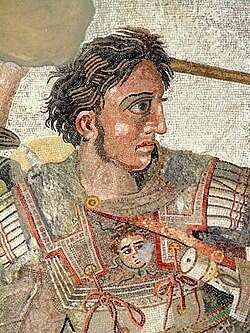
Alexander was born in July 356 BC and became king of Macedonia (Alexander III) upon his father, Phillip II's assassination in 336 BC, when he was 20 years old. He immediately began conducting military campaigns throughout Greece, Asia, and Egypt. By age 20, Alexander had created one of history's largest empires, stretching from Greece to northwestern India. He was undefeated in battle but died of an unknown cause in Babylon in June 323 BC, at age 32, a month before his next birthday.
| Alexander the Great mosaic |
| Mosaic discovered in the ruins of the House of the Faun in Pompeii (created c. 120-100 BC) |
|
|
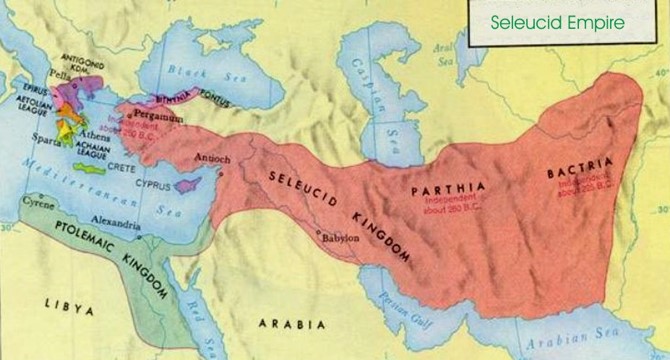
When Alexander died, his leading generals, called the Diadochi, fought for control of his empire. The Wars of the Diadochi marked the beginning of the Hellenistic period from the Mediterranean Sea to the Indus River Valley in India.
The most notable Diadochi included Perdiccas, Eumenes, Lysimachus, Cassander, Ptolemy, Seleucus, Antigonus, and his son Demetrius Poliorcetes, with Ptolemy, Seleucus, and Antigonus founding the Ptolemaic, Seleucid, and Antigonid dynasties that lasted for several centuries after the end of the Wars of the Successors, ruling in Egypt, the Levant, Asia-Minor, Mesopotamia, Persia, and Macedon.
The two successors who fought for control of Israel/Judah were Ptolemy, who became Ptolemy I of Egypt, and Seleucus, who became the first Seleucid king of Babylon and Syria. Initially, Israel/Judea was part of Ptolemy's Lagids dynasty, but once Antiochus had established his authority, he was determined to make himself king of Egypt and ruler of both kingdoms. In 197 BC, after the Battle of Baniyas, Ptolemy's army was defeated and the Seleucids took control of the Levant.
After receiving the Mesopotamian regions of Babylonia and Assyria in 321 BC, Seleucus I began expanding his dominions to include territories that include modern-day Iraq, Iran, Afghanistan, Syria, and Lebanon, all of which had come under Macedonian control after the fall of the former Persian Achaemenid Empire. At its height, the Seleucid Empire covered Anatolia, Persia, the Levant, Mesopotamia, and what is now modern Kuwait, Afghanistan, and parts of Turkmenistan in Central Asia.
1 Maccabees 1:10-15 ~ Antiochus Epiphanes: Israel Infected with Hellenism
10 From these there grew a wicked offshoot, Antiochus Epiphanes son of King
Antiochus; once a hostage in Rome, he became king in the 107th year of the
kingdom of the Greeks. 11 It was then that there emerged from Israel a set of
renegades who led many people astray. Come,' they said, let us ally ourselves
with the gentiles surrounding us, for since we separated ourselves from them
many misfortunes have overtaken us.' 12 This proposal proved acceptable, 13 and
a number of the people eagerly approached the king, who authorized them to
practice the gentiles' observances. 14 So they built a gymnasium in Jerusalem,
such as the Gentiles have, 15 disguised their circumcision, and abandoned the
holy covenant, submitting to gentile rule as willing slaves of impiety.
The 107th year, counting from 312 BC when the Seleucia dynasty was founded, was 175 BC. Then, in 188 BC, Antiochus IV Epiphanes, the descendant of Seleucus, the son of Antiochus III, and younger brother of Seleucus IV (cf. 2 Mac 4:7), was sent to Rome by his father as a hostage under the terms of the Treaty of Apamea between the Roman Republic and Antiochus III, ruler of the Seleucid Empire. The treaty ended the Roman-Seleucid War after the Roman victories at the Battle of Thermopylae (191 BC), the Battle of Magnesia (190 BC), and the Roman and Rhodian naval victories over the Seleucid navy.
According to Greek historian Appian, the treaty terms forced Antiochus III to abandon Europe and all of Asia west of the Taurus Mountains and barred him from recruiting mercenaries "north of the Taurus" (the territory ceded to Roman allies Pergamon and Rhodes). He also had to give twenty hostages, whom the Roman consul would select. The hostages would be replaced every third year, except for Antiochus's son, who was educated as a Roman. Antiochus III's son (Antiochus IV Epiphanes) was among the hostages handed over to the Romans in 189 BC after the defeat at the Battle of Magnesia in Sipyle.
Antiochus III was succeeded by his son, Antiochus IV Epiphanes, in 175 BC. The royal epithet Epiphanes means "who reveals himself in splendor" and indicates the king's claim to be the earthly manifestation of the supreme Greek god, Zeus. When Antiochus IV Epiphanes became king, some Jews had become so enamored with Greek culture and military success that they wanted to embrace Hellenistic culture, including its rituals and the worship of its pagan gods. (verse 11). Conforming to Hellenistic customs and religion was equivalent to apostasy from Yahweh and his Covenant. The Greek gymnasia (verse 14) were presided over by various Greek gods. "Becoming like the Gentiles" (verses 13-15) involved surgery to disguise the identifying sign of Jewish circumcision, a covenantal sign (Gen 17:10-14; 21:4; Ex 12:3, 44-48), when participating in the nude, as was the custom for men in gymnasium sports.1
Perhaps they had become disillusioned with the Covenant with Yahweh, particularly the extinction of the Northern Kingdom of Israel (722 BC) and then the southern Kingdom of Judah (587 BC). The prophets wrote that these disasters occurred because the people had failed to remain faithful to their Covenant with Yahweh. Perhaps it seemed to those who abandoned their faith that these disasters were vastly disproportionate to any sin the people or their ancestors may have committed. In other words, these Jews no longer behaved in a certain way so that Yahweh would bless them. Instead, they were seduced by the idea that Greek pagan gods could be offered sacrifices to convince them to enrich the lives of those who worshipped them, something Yahweh could not be bribed to do.
14 So they built a gymnasium in Jerusalem, such as the Gentiles have, 15 disguised
their circumcision, and abandoned the holy covenant, submitting to gentile rule
as willing slaves of impiety.
Jewish men wishing to adopt Hellenistic culture tried to disguise their circumcised
penises by having them scarred to resemble uncircumcised Gentiles. This act was
an attempt to cover over the sign of God's covenant with His people. For the
implications of such an act, see Genesis 17:9-14. Sacred Scripture and tradition
record that all will go well for God's covenant people as long as they remain
faithful to His covenant and observe His Law. However, when the Law is not kept,
and the covenant is broken, disaster can be expected to follow.
We see the same seductions occurring in the lives of former Christians or those who still profess their own versions of Christian faith. They fall away from the teachings of Mother Church and Sacred Scripture to form "faith communities" of their own that embrace modern attitudes and acceptance of what are considered mortal sins, like transgenderism, homosexuality, sexual mutilation of children, sexual promiscuity, and abortion, to name a few. Whatever feels right is acceptable, and there are no limits or penalties for bad behavior. These apostate Christians give themselves up to misplaced tolerance, misplaced mercy, and suicidal empathy that leads to divine judgment. In other words, they have deified themselves.
God warned humanity from the beginning against seductions by what "seems good," is "a delight for the eyes," and "to be desired to make one wise" (Gen 3:6; CCC 2541). Humankind must continually be on guard not to make the same deadly mistake as Adam and Eve.
1 Maccabees 1:16-28 ~ First Egyptian Campaign and Pillage of the Temple
16 Once Antiochus had seen his authority established, he determined to make himself king of Egypt and the ruler of both kingdoms. 17 He invaded Egypt in massive strength, with chariots and elephants (and cavalry) and a large fleet. 18 He engaged Ptolemy, king of Egypt, in battle, and Ptolemy turned back and fled before his advance, leaving many casualties. 19 The fortified cities of Egypt were captured, and Antiochus plundered the country. 20 After his conquest of Egypt, in the year 143, Antiochus turned about and advanced on Israel and Jerusalem in massive strength. 21 Insolently breaking into the sanctuary, he removed the golden altar and the lamp-stand for the light with all its fittings, 22 together with the table for the loaves of permanent offering, the libation vessels, the cups, the golden censers, the veil, the crowns, and the golden decoration on the front of the Temple, which he stripped of everything. 23 He made off with the silver and gold and precious vessels; he discovered the secret treasures and seized them 24 and, removing all these, he went back to his own country, having shed much blood and uttered words of extreme arrogance. 25 There was deep mourning for Israel throughout the country: 26 Rulers and elders groaned; girls and young men wasted away; the women's beauty suffered a change; 27 every bridegroom took up a dirge, the bride sat grief-stricken on her marriage-bed. 28 The earth quaked because of its inhabitants and the whole House of Jacob was clothed with shame.
Antiochus wanted to control both Egypt and Judea/the Levant. He invaded Egypt twice. The first invasion occurred in 169 BC, after which he attacked Jerusalem on the way back to Antioch, possibly to help finance his military adventure. The second attack on Egypt (see 2 Mac 5:1, 11-21) came a year later, in 168 BC. At that time, the Roman legate warned him that Egypt was under the protection of Rome, so he withdrew his army, but he took his rage out on Jerusalem for a second time, looting the Temple of its sacred objects. God's people were grief-stricken over the desecration of their sacred place of worship.
Viewing these events through the lens of faith, the writer believes God allowed the people of Judea to be punished for the sinfulness of covenant members who abandoned His covenant and urged others to follow their bad example. It is not surprising that the writer describes Antiochus in the same terms as another pagan king, Nebuchadnezzar of Babylon, because he also profaned the Temple and the Law (see 2 Kng 25).
The writer describes these events interspersed with two laments in verses 26-28 and verses 38-40, resembling the laments sung after the destruction of Jerusalem by the Babylonians in 587 BC (see the Book of Lamentations).
1 Maccabees 1:29-40 ~ Intervention of the Mysarch and Construction of the Acra
29 Two years later the king sent the Mysarch through the cities of
Judah. He came to Jerusalem with an impressive force, 30 and addressing them
with what appeared to be peaceful words, he gained their confidence; then
suddenly he fell on the city, dealing it a terrible blow, and destroying many
of the people of Israel. 31 He pillaged the city and set it on fire, tore down
its houses and encircling wall, 32 took the women and children captive and
commandeered the cattle. 33 They then rebuilt the City of David with a great
strong wall and strong towers and made this their Citadel. 34 There they
installed a brood of sinners, of renegades, who fortified themselves inside it,
35 storing arms and provisions, and depositing there the loot they had
collected from Jerusalem; they were to prove a great trouble. 36 It became an
ambush for the sanctuary, an evil adversary for Israel at all times. 37 They
shed innocent blood all round the sanctuary and defiled the sanctuary itself.
38 The citizens of Jerusalem fled because of them; she became a dwelling-place
of strangers; estranged from her own offspring, her children forsook her. 39
Her sanctuary became as forsaken as a desert, her feasts were turned into
mourning, her Sabbaths into a mockery, her honor into reproach. 40 Her dishonor
now fully matched her former glory, her greatness was turned into grief.
Mysarch (verse 29) was a chief collector of tribute (2 Mac 5:24) and probably a rank in the Seleucid army. Etymologically, it means "chief of Mysian mercenaries." Mysia was a region in Asia Minor. In Hebrew, sar musim or sar misim was distorted into sar missim, meaning "chief of taxes."
Systematic persecution of the Jews began in Jerusalem with pillaging personal property, plundering and desecrating the Temple, setting the city on fire, murdering its citizens, and taking others captive. On the western side of the city, on the high ground, Antiochus stationed a garrison in a fortress called the Acra or Citadel to demonstrate access to the Temple (cf. 2 Mac 5:24-25).
33 They then rebuilt the City of David with a great strong wall
and strong towers and made this their Citadel.
The part of the city associated with the revered King David had
grown to cover the large western hill of Jerusalem. After it was converted into
the Citadel of Acra, this quarter housed the Syro-Macedonian garrison and the
Hellenized Jews. It was a visible threat to the Temple, which stood lower down
to the east on what was called Mount Zion.
Antiochus III granted the people of Jerusalem a charter in 198 BC recognizing Mosaic Law as Jewish civil law. Still, Antiochus Epiphanes, seeking to unify his empire, abrogated that charter.
1 Maccabees 1:41-53 ~ Installation of Gentile Cults
41 The king then issued a proclamation to his whole kingdom that all were to
become a single people, each nation renouncing its particular customs. 42 All
the Gentiles conformed to the king's decree, 43 and many Israelites chose to
accept his religion, sacrificing to idols and profaning the Sabbath. 44 The
king also sent edicts by messenger to Jerusalem and the towns of Judah,
directing them to adopt customs foreign to the country, 45 banning burnt
offerings, sacrifices and libations from the sanctuary, profaning Sabbaths and
feasts, 46 defiling the sanctuary and everything holy, 47 building altars,
shrines and temples for idols, sacrificing pigs and unclean beasts, 48 leaving
their sons uncircumcised, and prostituting themselves to all kinds of impurity
and abomination, 49 so that they should forget the Law and revoke all
observance of it. 50 Anyone not obeying the king's command was to be put to
death. 51 Writing in such terms to every part of his kingdom, the king
appointed inspectors for the whole people and directed all the towns of Judah
to offer sacrifice city by city. 52 Many of the people "that is, every apostate from
the Law "rallied to them and so committed evil in the country, 53 forcing Israel
into hiding in any possible place of refuge.
Pagan empires were usually tolerant of the religions of their conquered peoples. However, Antiochus Epiphanes wanted to unite his territories politically by imposing Greek civilization and religion. To accomplish his goals in Judea, he attacked the three pillars of Jewish religion:
His plan was for Judaism to disappear or merge with Greek customs and religion as it had in other nations influenced by Hellenism. Jews who admired Greek culture and religion had no problem accepting his laws, becoming apostates to God's covenant with Israel. Other Jews conformed out of fear. Still others, whom the inspired writer sees as the true Israel (verse 53), suffered under persecution and were forced to go into hiding to stay true to their religious beliefs and customs.
1 Maccabees 1:54-63 ~ The Appalling Abomination
54 On the fifteenth day of Chislev in the year 145 the king built the appalling
abomination on top of the altar of burnt offering; and altars were built in the
surrounding towns of Judah 55 and incense offered at the doors of houses and in
the streets. 56 Any books of the Law that came to light were torn up and
burned. 57 Whenever anyone was discovered possessing a copy of the covenant or
practicing the Law, the king's decree sentenced him to death. 58 Month after
month they took harsh action against any offenders they discovered in the towns
of Israel. 59 On the twenty-fifth day of each month, sacrifice was offered on
the altar erected on top of the altar of burnt offering. 60 Women who had had
their children circumcised were put to death according to the edict 61 with
their babies hung round their necks, and the members of their household and
those who had performed the circumcision were executed with them. 62 Yet there
were many in Israel who stood firm and found the courage to refuse unclean
food. 63 They chose death rather than contamination by such fare or profanation
of the holy covenant, and they were executed. 64 It was a truly dreadful
retribution that visited Israel.
The inspired writer recalls the day that the holy Jerusalem Temple's altar, the one place to offer sacrifice to God, was profaned on December 8th, 167 BC. The revulsion that faithful, God-fearing Jews felt can be seen from the words used to describe the act—"the appalling abomination" (verse 54)—an act that recalls the prophet Daniel's "desolating abomination" (cf. Dan 9:27; 11:31; 12:11). In Hebrew, the words sound like the name Baal Shamem, "Baal of the heavens," recalling the Canaanite god which the early Israelites found attractive, which was condemned by the prophets (cf. 1 Kng 18:20-40) and evoking Olympian Zeus on the altar of burnt offerings. However, the words literally refer to something abominable that results in total perdition "a symbol of idolatrous worship that seeks to impose itself by force on worshipers of the One True God.
Jesus will use the same expression, "appalling abomination," in Matthew 24:15, when He announces the future tribulation to overwhelm Jerusalem: "So when you see the appalling abomination, of which the prophet Daniel spoke, set up in the holy place (let the reader understand), then those in Judaea must escape to the mountains; if anyone is on the housetop, he must not come down to collect his belongings from the house; if anyone is in the fields, he must not turn back to fetch his cloak. Alas for those with child, or with babies at the breast, when those days come! Pray that you will not have to make your escape in winter or on a Sabbath. For then there will be great distress, unparalleled since the world began, and such as will never be again. And if that time had not been shortened, no human being would have survived, but shortened that time shall be, for the sake of those who are chosen (Mt 24:15-22). Jesus gave this prophecy to announce the tribulation that would overwhelm Jerusalem when the Romans destroyed the city in AD 70 (forty years after Jesus's Resurrection). It was also intended to serve as a sign of the tribulations that would happen at the end of time just before His Second Coming.
The writer does not say exactly what was placed on the Temple altar; perhaps it was a statue dedicated to the Greek supreme deity, Zeus, or a pagan altar offering sacrifices to Zeus, as well as altars in other Judean cities. Incense was burned to honor Zeus in private homes and in the streets. The oppressors also burned the holy books of the Law (the five books of Moses). These acts were intended to inspire both terror and compliance. The covenant with Yahweh and adherence to Mosaic Law isolated the Jews as a foreign community inside the Hellenistic world established by Alexander the Great. Assimilation into the new culture offered material benefits, but it could not be achieved without breaking down the barriers Yahweh established that defined a unique covenant people.
59 On the twenty-fifth day of each month, sacrifice was offered on the altar erected on top of the altar of burnt offering. A monthly sacrifice was to be offered on the Jerusalem altar to commemorate the inauguration of the pagan altar at the Temple, and which also remembered the pagan king's birthday (see 2 Macc 6:7). Three years later, to the day, Judas Maccabeus will celebrate the rededication of the newly consecrated Temple altar (see 1 Macc 4:52ff)!
Anyone found with the books of Sacred Scripture was condemned to death. Women who had circumcised their sons according to the Law of Moses and their families were killed. Despite these horrors, there were many in Israel who stood firm and found the courage to refuse unclean food. 63 They chose death rather than contamination by such fare or profanation of the holy covenant, and they were executed. 64 It was a truly dreadful retribution that visited Israel.
Thanks to God's special providence and the people's obedience of faith, Israel/Judah kept its covenantal religious identity, enabling it to remain Yahweh's chosen people from whom would come the Redeemer-Messiah promised by the prophets, Jesus Christ! This is the message of the books of the Maccabees—a message embraced by Church tradition, which acknowledges them as part of Sacred Scripture and as examples of persevering in faith and obedience in times of trial.
Saint Augustine knew that the Jews did not regard 1st and 2nd Maccabees as having the same value as the books of the Law, the Histories, the Prophets, or the Psalms. However, he wrote: "... but they (the books of the Maccabees) will not have been received by the Church in vain if they are read or listened to calmly, and especially those parts that deal with the Maccabees themselves who, for the sake of God's Law, were true martyrs and suffered terrible and humiliating things" (St. Augustine, Contra Gaudentium, 1, 31, 38).
Endnote:
1. The Greek gymnasium functioned as a training facility for men wishing
to compete in public games. It was also a place for socializing and intellectual
pursuits, including worship of the Greek gods. The name comes from the ancient
Greek term gymnos, meaning naked or nude. Athletes competed nude in
sporting events, which was believed to encourage aesthetic appreciation of the
male body and serve as a tribute to the gods. To be accepted in a gymnasium,
Hellenistic Jews underwent surgeries to disguise their circumcisions by scarring
the skin of the penis.
Return to Lesson
Question for discussion or reflection:
What have you noticed about the
dominance of modernism among some professing Christians that, in truth,
separates them from true Christian faith and the teachings of Mother Church?
Catechism references for this
lesson (* indicates Scriptures are either quoted or paraphrased in the citation):
Spiritually unhealthy desires (CCC 2541-43)
Discerning between trials and temptations (CCC 2847*)
Michal Hunt, Copyright © 2026 Agape Bible Study. Permissions All Rights Reserved.