
The Christmas Octave and Symbolic Meaning of the Song, "The Twelve Days of Christmas"
The two principal feasts in the Liturgical Year are Christmas and Easter. These solemnities are the only feasts with octaves attached to them in which the feast continues for eight days, beginning with Evening Prayer on the eve of the feast. There are four Catholic celebrations in celebration of our Lord's birth: one for the vigil, one for the night, one for dawn, and one for daytime. Beginning with sunset on Christmas Eve, we make holy the four corners of the day: sundown, midnight, sunrise, and full daytime (in Jesus's time, a day began and ended at sunset).
Christmas is not a day but a season, lasting from Christmas Day until the feast of the Baptism of the Lord. The Christmas octave is the eight-day period during which the faithful celebrate the Christmas feast, including Christmas Day as the first in the count. The word octave means "eight" and refers to an eight-day celebration extended to the last day, called the "dies octave." Why eight days? The number eight represents perfection or rest. Some have traced the origins back to Jewish festival customs, such as the circumcision of a Jewish boy on the eighth day after birth. Also, the Jewish feast of Tabernacles lasted seven days, concluding with a solemnity that formed an octave, and Solomon's feast of the Dedication of the Temple lasted eight days. Jesus also rose from the dead on the eighth day, the day after the seventh day of the Jewish Sabbath (which is why Sundays are considered equal to solemnities).
January 1 is the Solemnity of Mary, the Holy Mother of God, and the eighth day, the Octave Day, of the Nativity of the Lord. January 6 is the twelfth day of the Nativity of the Lord, and the ancient day of celebration for the Feast of Epiphany. However, among Roman Catholics in the United States and Canada, Epiphany is now celebrated on the first Sunday after January 1, the Solemnity of Mary, the Holy Mother of God. In Europe, Latin America, and many Christian churches in North America, Epiphany continues to be celebrated on its traditional day, the twelfth day after the Nativity of the Lord. Epiphany marks the Magi's visit to the Christ child and marks the close of the Christmas season.
The Symbolic Meaning of the Christmas Carol "The Twelve Days of Christmas"
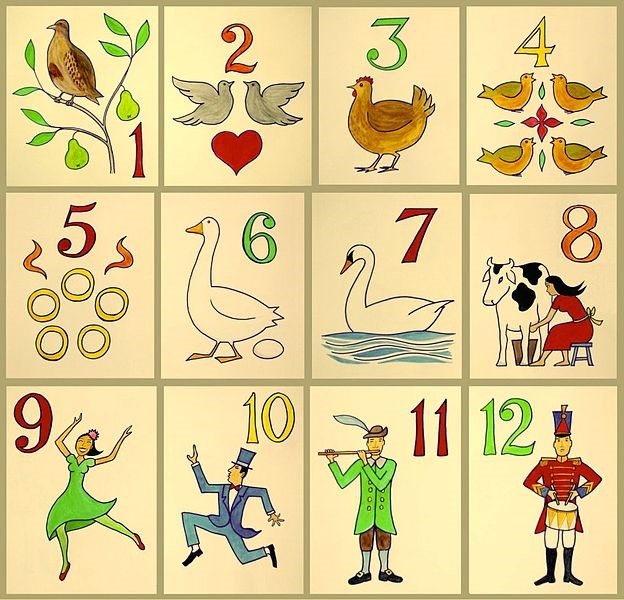
On December 25th, we celebrated the birth of Christ the Savior and the beginning of the Twelve Days of Christmas, the countdown to the Feast of Epiphany. The Christmas season, however, doesn't officially end until after the Feast of the Epiphany on the following Sunday, when we celebrate the Baptism of the Lord, which marks the First Sunday in Ordinary Time. During the twelve days between Christmas and Epiphany, a popular Christmas carol is "The Twelve Days of Christmas." It was a song written in 16th-century England during a time of intense religious persecution of Catholics. The persecution began when the English government ordered the English church to separate from the Roman Catholic Church and form its own apostate church. The reason for the separation was that Pope Clement VII refused to grant King Henry VIII an annulment from his twenty-year marriage to Queen Catherine so he could marry his pregnant mistress, Anne Boleyn. During this time, and under the reigns of Henry's two Protestant children, Edward VI and Elizabeth I, many Catholics, including priests, were burned alive as martyrs of the faith. Each line of the song was written for the purpose of using symbols that were catechetical devices to secretly teach children about the Catholic faith, a crime in England at that time.
"On the first day of Christmas, my true love gave to me, a partridge in a pear tree": "My true love" refers to God (Father, Son, and Holy Spirit). The "me" is the individual Catholic who is called to remain faithful to the teachings of Jesus Christ and His gift that is the Church. The symbolic meaning of the partridge and the pear tree will be revealed at the end of the song when the phrase is repeated.
"Two turtle doves" symbolize the two natures of Jesus, who is fully human and fully divine, and the two Testaments, the Old and New, that together comprise the Christian canon of Sacred Scripture. They are like the two lungs in the body of a healthy person that sustain life in the same way that the study of the Sacred Scriptures in the Old and New Testaments is necessary to the healthy life of the Church.
"Three French hens" are the three gifts the Wise Men gave the Christ child (gold, frankincense, and myrrh), and the Three Persons of the Godhead (Father, Son, and Holy Spirit).
"Four calling birds" are the Four Gospels of Sts Matthew, Mark, Luke, and John that record the accounts of Jesus' ministry in His miracles that proclaim His messiahship and His teachings that call all men and women to a New Covenant in the era of the Church, Jesus' Kingdom of Heaven on earth.
"Five Golden Rings" are the first five books of the Old Testament, which tell the story of the beginning of God's relationship with humanity and His relationship with the children of Israel, His first covenant people, called out from the other peoples of the world.
"Six geese a laying" are the six days of creation and the six commandments of the Church.
The six commandments of the Catholic Church are the "Catechism of Christian Doctrine," approved by the Catholic bishops of England:
- To keep the Sunday and Holy Days of obligation holy by attending Mass and resting from servile work.
- To keep the days of fasting and abstinence appointed by the Church.
- To go to confession at least once a year.
- To receive the Blessed Sacrament at least once a year and at Easter.
- To contribute to the support of Catholic pastors.
- To not marry within a certain degree of kindred, nor to solemnize marriages at forbidden times of the liturgical year.
This list is the same as that prescribed by the Fathers of the Third Plenary Council of Baltimore for the United States in 1886. Today, these commands are summarized in the five precepts of the Church in the Universal Catechism (see CCC 2041-46).
"Seven swans a swimming" symbolize the Seven Sacraments of faith given to us by Christ Himself to sustain the faithful on their journey to salvation, and the seven petitions of the "Our Father" prayer, which Jesus taught His disciples. (Matthew 6:9-13)
"Eight maids a milking" represent Jesus's spiritual teaching on a transformed life that provides the pathway to heaven in the New Covenant Law of the Beatitudes (Matthew 5:1-12).
"Nine drummers drumming" are the nine orders of angels that serve God in the heavenly Sanctuary and are sometimes sent to earth as His messengers. Scripture lists their orders as: Angels, Archangels, Virtues, Powers, Principalities, Dominations, Thrones, Cherubim, and Seraphim. (Genesis 16:7-11; 22:11, 15; etc.; Exodus 3:2; 14:19; etc.; Isaiah 6:1-7; Revelation 4-6; Jude 9; 1 Thessalonians 4:16; Romans 8:38; 1 Corinthians 15:24; Ephesians 1:21; 3:10; 6:12; Colossians 1:16; 2:10, 15; etc.)
"Ten ladies dancing" are the Ten Commandments that are binding upon the people of God both in the Old and New Covenants (Exodus 20:3-17; Deuteronomy 5:7-21; CCC 2067-68).
"Eleven pipers piping" are the eleven Apostles who remained faithful after the treachery of Judas Iscariot. They are examples of how every Catholic Christian is to remain faithful to Jesus and His Church. Jesus appeared to them after His resurrection, breathing upon them His Spirit and giving them the power to govern His Church by forgiving sins in the Sacrament of Reconciliation (John 20:21-23).
"Twelve lords a leaping" are the twelve fundamental beliefs of the Catholic Church as outlined in the Apostles Creed.
"And a partridge in a pear tree": a partridge is a common, ground game bird in England that does not roost or make its nests in trees, so a partridge in a tree is a relatively uncommon sight. The "partridge" is a symbol for the Messiah, Jesus Christ, and the "pear tree" is the Cross upon which Jesus offered up the gift of His life for the salvation of the world.
So, the next time you sing the song, remember it is not a song about twelve odd gifts during the twelve days of Christmas. It is instead twelve gifts of love from God the Son to the people of His Kingdom, the Catholic (universal) Church.
Michal Hunt, Copyright © 2014; revised 2025 Agape Bible Study. Permissions All Rights Reserved.